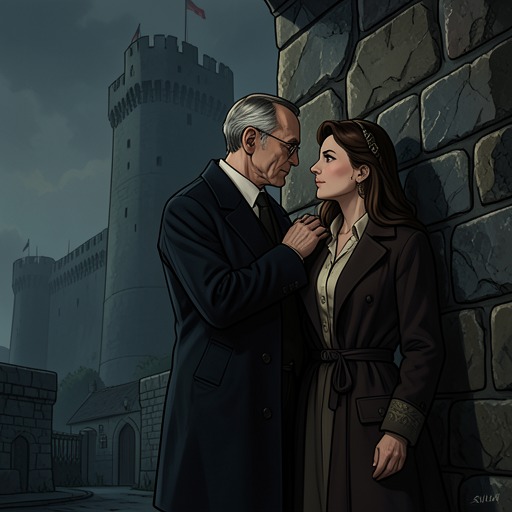
Goldmund and Lydia’s Secret Love Affair
Narcissus and GoldmundGoldmund and Lydia’s Secret Love Affair begins when Goldmund, a homeless traveler, accepts work and shelter at the home of a prosperous knight, and becomes a hidden relationship in which desire gives way to mutual tenderness without resolving their incompatible futures. Lydia’s jealousy brings their attraction into the open; their private hours make Goldmund feel loved for the first time, even as Lydia understands that he will eventually leave her household and return to the roads.
Arrival at the Knight’s Household
Goldmund has been on the road for a year or two when, in early autumn, he asks the prosperous knight for food and a bed. Concerned about the coming cold, he is glad of shelter; his knowledge of Greek also earns him an invitation to the knight’s table. There he meets the knight’s daughters, Lydia, who is eighteen, and Julie, who is sixteen. At first he expects to move on: he sees no prospect of winning either young woman and has no other reason to remain.
The next morning, however, the knight shows Goldmund the writing room and a chest of collected scrolls. A former scholar who turned to warfare and worldly affairs, the knight had later gone on pilgrimage and, in old age, begun writing an account of it. His Latin is faulty, so he offers Goldmund clothes and free lodging in exchange for correcting and copying the existing chapters and helping complete the book. The offer answers Goldmund’s immediate need for winter shelter, but the prospect of living near the two sisters matters to him as well. He accepts, and negotiates for a handsome outfit halfway between a page’s and a huntsman’s rather than the black scholar’s gown the knight had imagined.
Goldmund works with the knight each day, improving the Latin and recasting some of its short, awkward sentences. Outside the writing room he hunts, learns to use a crossbow from the huntsman Heinrich, rides, and spends time with the household’s people and animals. He keeps apart from a nearby miller’s wife, while his attention turns to the daughters. Julie remains shy and distant. Lydia questions him about his life in the cloister with teasing irony, and Goldmund takes her willingness to talk as a sign that he is making progress.
Jealousy Makes the Attraction Visible
The relationship changes when visitors arrive and the knight’s guest room is reassigned to them, moving Goldmund’s bed into the writing room. At the dinner, Goldmund notices the visiting woman’s interest in him and responds to it. Lydia, previously a teasing conversational companion, grows quiet and watches him closely. His flirtation is not hidden from her: their exchanges at the table take on an unmistakable charge, and Lydia reacts with mounting jealousy while Julie withdraws.
The next morning, as the visitors prepare to leave, Lydia watches Goldmund help the woman mount her horse. Soon afterward Lydia rides out of the courtyard. Goldmund follows her through the cool, overcast countryside. He sees her silhouette on a ridge, pursues her as she rides away, and catches up when she lets her horse slow. The pursuit changes the terms of their contact: Lydia’s flight and his decision to follow make their mutual concern harder to disguise, though she is still angry about the previous evening.
When Goldmund stops her, Lydia breaks into tears. She reproaches him for flirting with the visitor in front of her and for coming after her now that the woman has gone. Goldmund recognizes that he has acted wrongly and does not try to contradict Lydia’s distress. He reads love in her expression as well as hurt, apologizes, and tells her he loves her. In this exchange, the affair is no longer only Goldmund’s hope that he has attracted her; Lydia’s jealousy reveals the depth of her own attachment, even while her spoken rebuke insists on the injury he has caused.
They ride back toward the household together. Near the entrance Lydia worries that they should not have returned at the same time, exposing the need to keep their connection private. Before they part, she asks whether he was with the visiting woman the previous night; Goldmund shakes his head. Later that afternoon Lydia comes to the writing room and asks whether his answer was true. Their private meetings begin to take shape around this unresolved suspicion and the trust it requires.
A Private, Unequal Future
Goldmund and Lydia find a secret hour together each day. The pace and limits of their intimacy are often set by Lydia: sometimes they hold hands and exchange a childlike kiss; sometimes she kisses him but does not allow him to touch her. On one occasion she lets him see one breast, then covers herself again. Their meetings also include conversation. They invent names for one another, and Lydia tells him about her childhood, dreams, and games. The relationship is therefore not simply an episode of attraction for Goldmund, who has been learning about love through successive encounters with women. For the first time, he feels not merely desired but loved.
The happiness they find together carries a recognized obstacle. Lydia says that their love is wrong because Goldmund cannot marry her. She speaks of this impossibility sadly and accepts secrecy as part of their bond. Her understanding of the situation is not limited to marriage: she sees his homelessness and the likelihood that he will leave. She tells him that the sadness in his eyes seems connected to his life on the road. If he goes, she will still have her father, her sister, her room, and a window from which to remember him, but she will no longer have a home in the deeper sense she associates with their love.
Lydia imagines Goldmund’s future as unlike an ordinary settled life. She thinks he might become a poet, traveling through the world and winning women’s affection while remaining alone, and urges him to return to the cloister and his friend Narcissus. She also fears that he may die alone in the forest. Goldmund does not answer her anxieties with promises of a shared future; he comforts her through gentle affection. Their relationship is thus intimate but knowingly provisional: Lydia can name the separation approaching, while Goldmund’s wandering vocation gives no assurance that he can stay.
Narrative Significance
The affair gives the knight’s household, initially a practical refuge from winter, a different importance in Goldmund’s journey. His work for the knight, his conversations with Lydia, and the daily secrecy of their meetings hold together a temporary life that is neither the cloister nor the open road. Yet that brief domestic setting cannot turn him into a settled partner. The relationship’s central tension lies in the contrast between Lydia’s rooted home and Goldmund’s homelessness, a difference she articulates before it becomes an actual departure.
The episode also revises Goldmund’s developing understanding of love. His wandering has taught him to observe and distinguish women, but Lydia’s attachment gives those experiences a new emotional dimension. He is affected not only by being wanted but by being known and loved, and Lydia’s attention extends to the sorrow and solitude she perceives behind his outward happiness. The affair remains secret, its future constrained by marriage and his itinerant life; its importance rests in the intimacy it briefly creates and in the recognition that this intimacy cannot secure permanence.